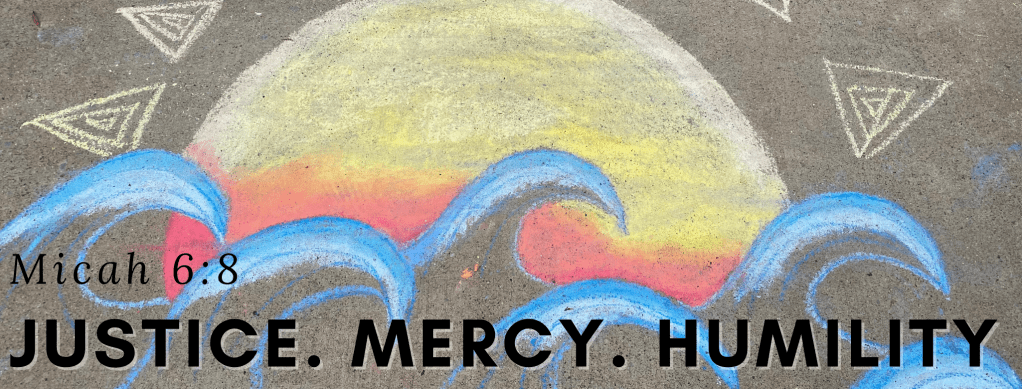
“What does the Lord require?” is a question that Micah addresses in his time, and one we are asking today. For the prophet, it was three unique characteristics: God requires justice, mercy, and humility. It seems simple and straight forward, but as I look around our world, I see young people dying because of their skin color. I see mass shootings and wonder how many people have to die before taking a hard look at the culture of violence. I see people looking for freedom and safety for themselves and their families, and they are met with, “Not in my country or not in my back yard.” I see a world looking for a voice—a prophetic voice calling us back into God’s divine image.
For the people in Israel and us, that voice comes from Micah. Micah knew that justice would not come from the state or the power structure, for they get caught up in matters of comfort, prosperity, and security. Justice, as history has shown, arises out of the people themselves, fueled by God’s grace, to envision change, a counter-cultural way of doing things. To do justice is not a romantic ideal nor an abstract concept. Instead, I have found that justice is excruciatingly hard work. For it asks of us as a people to work together, to truthfully critique the present unjust system, and to find new alternatives to change the system. Justice can disrupt, dismantle, break down, disarm, and transform systems and people when we dare to see what is really happening here and around the world without growing cynical and closed off. We can see all kinds of injustices and tragedies, but seeing it is not enough. For it is in seeing the injustice and being moved to do something about it that we dare to change what is unjust.
God requires mercy. Jesus embodied this type of mercy as he wept, prayed, broke bread, touched, and healed people. These are real flesh and blood examples of loving-kindness, loving tenderly, loving steadfastly. And, yet, in our society, to love kindness does not come easily. Perhaps that is because loving tenderly involves knowing confidently one is loved and can take the risk to be moved, be vulnerable, and be able to see another person’s suffering as one’s own.
God asks we walk humbly with the Divine. To walk humbly is to neither have your nose up in the air nor your shoulders slouched over your feet. To walk humbly is not to exalt yourself, not to worry or be bothered by other people’s opinions of you. To walk humbly is not to be above someone or below someone, but rather with someone. It is not thinking you can do it all on your own, carrying the burdens upon your limited human shoulders. It does not forget you are human. It is not living without grace. It is not playing God. Walking humbly with God is about paying attention, paying attention to who we are and what is around us, listening to the cries and the stories of other human beings, and our own stories, waiting on God. We must know our story before we can be there for another. We must love ourselves before we can love another.
“What does the Holy One require of us? To make justice happen; to love passionately as the Holy loves; and to be the Divine image in the world!” (Micah 6:8, Rev. Dr. Lisa Davison translation)
 Youth of Geist Christian Church