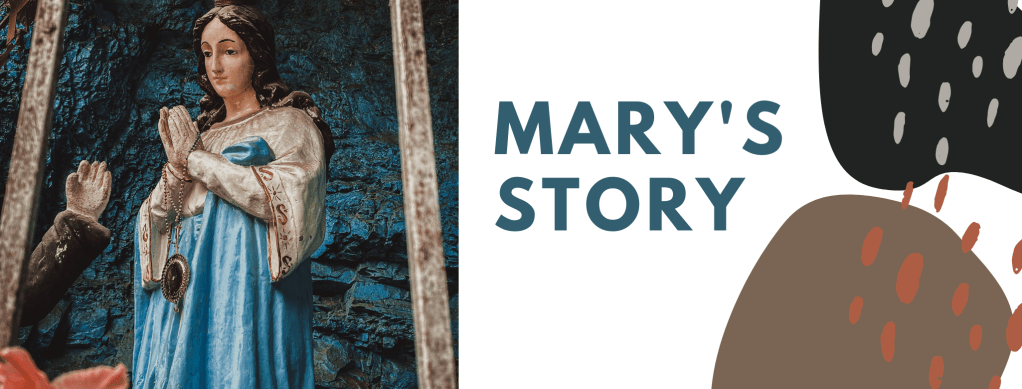
Mary’s Story

Years ago, a colleague of mine share two diverse experiences of young women who were pregnant. The first was of a girl in his homeroom class. For years, they shared the same row, with her name coming just before his in the taking of daily attendance. One day, no response. Then another. At first, my colleague didn’t realize the cause of her absence. “She must be sick,” he thought. Then one day turned into one week, and one week turned into one month. As time passed, rumors began to swirl of the young girl’s absence. “She pregnant,” people would whisper. He would go on to share that, in those times, to be pregnant at her age was a scarlet mark. She was pushed to the fringe of society, with little help and the stigma of what had happened. Can you imagine the pain? Can you imagine how scared she might have been and how alone she might have felt? 

The other story shared in his sermon was of his sister who had tried to get pregnant. For years they had wanted a child, and even with the help of doctors and modern medicine, the option of childbirth seemed to elude them. At the brink of looking for alternative options to becoming parents, she called her brother with the news. “I’m pregnant,” she said. The joy leaping from the phone as her prayers had finally been answered. Can you imagine the joy? Can you imagine how happy she might have been, surrounded by friends and family who would love, care, and support this child as their own?

Two diverse stories of expectant mothers, with two different trajectories. As you hear these stories, you might be asking yourself the same question this pastor posed to his congregation: “Which story more accurately embodies Mary’s story?”  My guess is both. Over these past few weeks, we have been reminded of her story. The fear of telling Joseph that she is pregnant. The pain and uncertainty of how the community will react. The joy of telling her cousin Elizabeth that she is with child. The hope of what is to come with their family and this child. 

Fear and joy are part of Mary’s story. It’s part of our story, too. Through it all, Mary remains devoted to a God who is ever-present and always faithful for she says,

“My soul magnifies the Lord,
and my spirit rejoices in God my Savior,
for God has looked with favor on the lowliness of the Almighty’s servant.
Surely, from now on all generations will call me blessed;
for the Mighty One has done great things for me,
and holy is God’s name.
God’s mercy is for those who fear God
from generation to generation.
God has shown strength with God’s arm;
God has scattered the proud in the thoughts of their hearts.
God has brought down the powerful from their thrones,
and lifted up the lowly;
God has filled the hungry with good things,
and sent the rich away empty.
God has helped servant Israel,
in remembrance of God’s mercy,
according to the promise God made to our ancestors,
to Abraham and to his descendants forever.

In this Advent season, may we see the depth of Mary’s story. May we see her fear and her joy, and may we learn how to respond to a God who calls us all to bear light unto the nations. 

The Warmth of Christmas

For many of us, this season brings with it a flood of emotions. Some of us might be overcome with Joy, Peace, Hope, and Love as we watch the Advent candles progress each week. Others, full of anxiety and pain as they deal with the death of a loved one, worrying about mounting financial debts, or struggling with tension in their relationships. And let us not forget that we have found ourselves nine months into a pandemic leaving us all tired, stretched thin, and seeking respite from the groundhog-day-cycle life has become for many these days. So, we wait. We wait to hear old stories, and to celebrate, among the joys and sorrows of life, a child born in a manger. 

Among the wise men and women, shepherds watching their flock, heavenly angels, and a star, the scriptures remind us that the King of kings was born in a manger, in a cattle stall among the muck of life. Unexpected turns and chaos paint a very scary first Christmas, and yet, there God is. One must say to themselves, if the son of God can arrive in such circumstances, so can truth. So can joy. So can peace. So can love. These stories remind us that God appears to the less than perfect and less than powerful. Sinner or Saint, Adult or Child, Prophet or Shepherd. By appearing to shepherds, God showed God’s willingness to appear to any who will listen with the wonderful message that “unto you a child is born.” 

Too often we look for God in the beautiful, in the times and places we set out to seek God. However, Advent reminds us that sometimes God seeks us. Like the prophets of old, we have waited patiently for this Good News. We have tuned our ears beyond the hustle and bustle of holiday shopping, and in the stillness of night, have heard the angels sing of a child born in a manger. We have watched things transform all around us.  Evergreens now fill our stark homes and places of worship. Lights shine bright and colorful presents pull us in and let us know that something magical is taking place. It’s as if we are embarking on a journey to a destination unknown, but anxiety of not knowing does not fill us. Instead, we are overcome with hope and promise of what is to come. Our waiting. Our listening. Our watching has all been filled with a very simple prayer, a prayer that comes so natural it’s as if we are simply breathing. This breath, this prayer brings forth love, justice, and righteousness. It brings forth new beginnings and celebrates a life well-lived. It brings forth a peace that seems to pass all understanding. 

The season of Advent, a season that prepares us for the coming Christ child, will soon come to a close for, “unto us a child is born,” Emmanuel, God with us. The shepherds know. The wisemen and women know. The animals surrounding the manger know. Mary and Joseph know. We know. As Hilda Lachney Sanderson puts it, 

“Yes, God, I know it’s Christmas; 

I feel it all around, 

Not just because of songs I hear 

Or snow upon the ground. 

I know because my soul is quiet, 

Contented and at peace, 

As all thoughts born of greed and such 

Have suddenly seemed to cease. 

I feel a gentle kindness 

That is creeping up on me, 

And not because of gifts beneath 

A lighted Christmas tree. 

Yes, God, I’ll try to make it last 

Throughout the coming year, 

While right now I just warm myself 

In Christmas love and cheer.” 

Let the warmth of Christmas overtake you. Let the Christmas love and cheer penetrate the darkness within you and within our world. Let God surprise you this season, for we know that the Christ child lives within and among us.  

called to bring peace

Dr. Halverson pastored Fourth Presbyterian Church in Bethesda, Maryland for twenty-three years. He did what pastors do – everything from preaching and counseling to marrying and burying. But he believed his most important function was pronouncing his carefully crafted benediction at the end of each service:

Wherever you go, God is sending you.
Wherever you are, God has put you there.
God has a purpose in your being right where you are.
Christ, who indwells you by the power of his Spirit,
wants to do something in and through you.
Believe this and go in God’s grace, God’s love, God’s power.
In the name of the Creator, Son, and Holy Spirit.
Amen.

Dr. Halverson reminded his congregation of that simple truth that each of us are called week in and week out until his death. Sometimes the voice speaking sounds to us as a resounding gong, shouting to go forth and serve, or it might come in the middle of the night as a small whisper highlighting the gifts you have for the journey ahead. Be it large or small, we are empowered to speak God’s word accurately and with courage, even during days when the Word of the Lord is rare. This movement toward speaking, acting, living out the word of God pushes us into the unknown and asks us to dare greatly. FDR said, “It’s not the critic who counts; not the man [sic] who points out how the strong man [sic] stumbles or where the doer of deeds could have done them better. The credit belongs to the person who is in the arena. Whose face is marred with dust and sweat and blood, who strives valiantly … who at their best knows in the end the triumph of high achievement, and who at their worst, if he [sic] fails, at least fails while daring greatly…”

         In her book Daring Greatly, Brené Brown says this quote made her realize three things. First, she wanted to be the person in the arena. “If we want to be courageous and we want to be in the arena, we’re going to get knocked down,” she says. “There is no option. If you want to be brave and show up in your life, you’re going to fail. You’re going to stumble. You’re going to fall. It’s part of showing up.”

         The second thing she realized is that comments from “Twitter trolls” — people who never risk anything but criticize the people who do — don’t matter. “If you are not in the arena also getting knocked down, I’m not interested in your feedback,” Brown says.

         The third thing culminates everything Brown has learned over the past two decades of studying shame and vulnerability. “Vulnerability is not about winning, it’s not about losing — it’s about having the courage to show up and be seen,” As faithful people, we must be willing to dare greatly, to step into the arena of life, and live through acts of justice, peace, reconciliation, and love. We must be willing to embrace the vulnerability that comes with stepping into the unknown and walk as one loved by God and called by God to be a light unto the nations. As we continue our Advent journey, may we join in God’s beloved story of birth, knowing that we have been named, claimed, and called to bring peace, hope, joy, and love into this world. This coming together is what God’s story is all about, and when we open ourselves up to God and each other, we are able “rejoice together, mourn together, and to delight in each other and make other’s conditions our own.” So, believe this and go in God’s grace, God’s love, God’s power. Let there be peace on Earth, and let it begin with us.  

Season of Giving

We are entering a Holy Season. A season where we should be sensitive to God coming into our world. On the surface, all looks to be going as planned. The trees are up, and our houses would make Chevy Chase jealous. The 24-hour Hallmark station on XM Radio is in full swing, while Amazon boxes are beginning to obstruct our front doors. Advent is here, and yet, the joy and innocence that surrounds this season seems to feel as if it might break under the weight of social unrest, political instability, loss of human connection, and Covid-19.  

In a season where hope, joy, peace, and love are the stars of the show, I have had to work hard in seeing these foundational pillars of faith take shape in our world. It’s not easy to find hope when division and tribalism take hold of our communities. It’s not easy to be joyful when so many are struggling to put food on their table or keep a roof over their heads. It’s not easy to find peace when we seem to be at war with each other and our creation. It’s not easy to love when so many seem unlovable. Add in a pandemic, and what you have is a level of uncertainty and fear that no one has ever experienced.

However, we fail to see the bigger picture because these feelings are not new for our generation. They transcend our own time and place. For in Jesus’ birth story, we see the same chaos that consumes us today. The reality is that Jesus was born into a violent political system. Beyond mangers and angels, shepherds watching their flock by night, and Magi following a star in the night sky, uncertainty, fear, and violence were the backdrop to the birth story.

One commentator once compared Matthew’s version of the birth story to an obnoxious and most unwelcome guest at your Christmas party—the kind of person who talks too loudly, spills eggnog all over your nice clean rug, and is always the last to leave. The so-called “Slaughter of the Innocents” is about as un-Christmasy a Bible passage as we could imagine. Yet innocence is what has been lost in our story and this story. 

But among the chaos, uncertainty, and sadness, there is a God who remains ever-present and forever faithful. As we move through the valley of the shadow of 2020, and as we approach ever closer to the gift of Christ’s birth at Christmas, I think words written by Annie Dillard are worth remembering and repeating. In fact, I believe they have some saving graces for all of us this year.

“One of the things I know about writing is this: spend it all, … play it, … all, right away, every time.”  Dillard goes on to say that “the impulse to keep to yourself what you have learned is not only shameful, it is destructive. Anything you do not give freely and abundantly is lost to you. You open your safe and find ashes.”

As with writing, so with the gifts we give at Christmas time. Now more than ever we need faith, hope, love, joy, peace, cherishing honor, tender listening, comforting support, caring compassion, seeing our own tears in another’s eyes, sacred laughter.

For if we refrain from giving our gifts, we choose self and wait for something better. We limit the Spirit, blessings, and gifts that have been showered upon us. As Annie puts it, “Do not hoard what seems good for a later place in the book, or for another book; give it, give it all, give it now. The impulse to save something good for a better place later is the signal to spend it now. Something more will arise for later, something better. These things fill from behind, from beneath, like well water.”

Again, as with writing, so with the best gifts we give at Christmas. The gist of the Christmas story is this: God did not hoard the birth of Christ for a better place later or for another world or another time. And neither should we. In the loving gift of Christ, God gave it all and continues to give it all now, in our time, as well.

So, this Advent season, let us all share and sing and tell everyone about the gift of God’s love – wherever we are, wherever we go – along with the other best gifts we know – faith, hope, love, joy, peace, cherishing honor, tender listening, comforting support, caring compassion, seeing our own tears in another’s eyes, sacred laughter.  Give them, give them all, give them now! 

attitude of gratitude

Thanksgiving is just around the corner, and my guess is it will look a little different than in years past. Instead of large gatherings with extended family, we might find ourselves staying home with those closest by our side. It might not be what we had planned or wanted, but much of this season has been filled with unexpected turns, reimagined celebrations, and new ways to stay connected. Sure, our tables might be smaller, our meals missing a few essential dishes, but the meaning remains the same. Thanksgiving is a time for us to pause from our busy lives, something we have done more of this year. Instead of lamenting about the things we have lost or felt anxious about what is to come, Thanksgiving calls us to stop, breathe in God’s grace, and give thanks for the blessings we do have in our life. It also grounds us in the Divine, so that can weather life’s storm. 

Meister Eckhart, a well-known mystic, believed that thanking God was the most important prayer. Prophets and monks learned that gratitude brings you closer to God. Thanksgiving enables you to see your life in a broader context beyond your immediate troubles. It expands your life experience, from the present to the whole. It counteracts preoccupation with losses, fears, and wants. It helps us embrace an attitude of gratitude. Living with an attitude of gratitude means that we live our lives in a way that shows thankfulness for everything – both in the good and bad circumstances we experience in life.  

Teddy Roosevelt once said, “Comparison is the thief of joy.” Do not let the thoughts of what could have been in 2020, or the fear of what the beginning of 2021 might be, rob you of the joy you have experienced or could experience. Yes, we have all lost out on some great things this year, but if you take the time and do the hard work of reflecting on the totality of the year, my guess is there will be plenty of blessings, both big and small, to give thanks to God for this year. May those blessings provide you with warmth and comfort this Thanksgiving as you embrace and live out your attitude of gratitude into the new year. 

mark of the Divine

Francis Dorff has a wonderful story called “The Rabbi’s Gift,” which illustrates how important it is for us recognize, claim, and not take for granted that God is with us each and every day. The story goes like this:

          There was a famous monastery, which once had been full of monks and visitors seeking spiritual guidance. However, the monastery had fallen on dry years when their spirituality level was very low. Few pilgrims came to seek guidance, and few young people gave themselves to become monks. At last, there was only a handful of elderly monks going about their work, their prayer, and their study with heavy hearts. The only time their spirit seemed to lift was when the word went out that the rabbi was walking in the woods. You see, in the woods near the monastery, there was a small hut that this rabbi had constructed as a place of retreat, and he came from time to time to fast and pray. When the monks in the monastery knew he was fasting and praying, they felt supported by his prayer.

           One day, the abbot of the monastery, hearing that the rabbi was walking in the woods, decided to go see him. When he reached the little hut, there was the rabbi standing in the doorway with his arms outstretched, as if he had been standing there for some time to welcome the abbot, who had given no notice of his visit. They greeted one another and then went in the simple hut where there was a table with a book of scripture opened on the table. They sat there, silently prayed, and then the abbot began to weep. He poured out his concern for the monastery and for the spiritual health of the monks. Finally, the rabbi said, “You seek a teaching from me, and I have one for you. It is a teaching which I will say to you and then I will never repeat. When you share this teaching with the monks, you are to say it once and then never to repeat it. The teaching is this. Listen carefully. ‘The Messiah is among you.’”

           Well, when the abbot heard that teaching, he thanked the rabbi. He went back to the monastery to gather the monks and to tell them the teaching of the rabbi. He told him, as he was instructed, that he would say the teaching once, and then they were to talk about it no more. “Listen carefully,” he said. “The teaching is this: One of us is the Messiah.” It wasn’t exactly what the rabbi had said, but they began to look at one another in a whole new light. Is Brother John the Messiah? Or Father James? Am I the Messiah?

As beloveds created in the image of God, we all bear the mark of the Divine. We are God’s hands and feet and should care for this world and its people as if we are caring for God. I often remind the youth that if they want to see God, simply look left and then right. How we treat people, treat the environment, treat ourselves directly impacts the One who created and gave us life. The Messiah is among you, because each of us has the Messiah within. So, go boldly, with eyes open to see the Divine within yourself, our world, and those who live in it. Go and be a light unto the nations.  

Polar Star

In the Letter to the Ephesians, we are introduced to a church that has been divided into two camps. Much like our modern world, Ephesus was a diverse community. In ancient times, it was booming metropolis. Located on the Aegean Sea, it was a center for travel and commerce, which brought with it a culturally-diverse experience. With diversity comes new ideas and ways of looking at every aspect of life. 

Sometimes, we welcome these changes, and sometimes we struggle. Sometimes change needs to occur, and sometimes the old way was “not broken.” As the writer sees it, there’s apparently been a takeover movement by Gentiles, who neither know nor care much about Israel and its place and salvation history. Its traditions and practices are odd and strange to those of pagan heritage and are being dismissed as archaic and increasingly irrelevant to “real life.” 

Moreover, these new Christians are, in the eyes of their Jewish brothers and sisters, too enamored with the easy-going morality of the dominant culture, calling it “Freedom in Christ” and citing the Apostle Paul as their justification for offensive practices. Old versus new, progressive versus traditional, classic versus contemporary have been time-honored camps that the Church has often found itself divided into.

To address this divide, and to correct misinterpretations of Paul, the writer of Ephesians presents a vision of what God is up to in this community. Something new is clearly happening in the convergence of radically different traditions of religious experience that can be attributed, according to the writer, to the ongoing work of Christ. God is at work in Christ, revealing, adopting, sacrificing, and blessing in order to bring different communities together into a new unified body. The claim is bold, yet simple, that through the death and resurrection of Christ, warring religious cultures, passionately divided by heritage, traditions, moral codes, and behaviors have collided and now converge into a newly created order, a community that knows no barriers of race, class, or gender. 

The foundation is Christ, and we are called to move from what God is doing to what we should be doing as a community of faith. We are being shown how to transition from laying out a grand vision of what God has done in Christ to the question, “How does this lofty vision play out in congregational life?” The answer, “Unity.” 

The writer of this text points out that unity is not just given but is also a goal for the community to embrace. Unity is not just something Christians passively accept or reject, it is something we choose to do. The maintenance of unity requires “every effort” on the part of the church to create a space of grace where diversity in life and practice is honored. “I’m a love-filled Christian” is not just a slogan or catchphrase, but a recognition, acceptance, practice, and celebration of gifts given to the community “for building up the body of Christ.”

So, as we move from this election and into a new season, how are we to build up the body of Christ? How do we move beyond that which divides us and live into a community where unity is our polar star?

Touched

Enjoy a guest blog post from friend and fellow pastor Christopher Furr.

Mark 1:40-45: A man with a skin disease approached Jesus, fell to his knees, and begged, “If you want, you can make me clean.”Incensed,[a] Jesus reached out his hand, touched him, and said, “I do want to. Be clean.” 42 Instantly, the skin disease left him, and he was clean. 43 Sternly, Jesus sent him away, 44 saying, “Don’t say anything to anyone. Instead, go and show yourself to the priest and offer the sacrifice for your cleansing that Moses commanded. This will be a testimony to them.” 45 Instead, he went out and started talking freely and spreading the news so that Jesus wasn’t able to enter a town openly. He remained outside in deserted places, but people came to him from everywhere.

There are certain kinds of sicknesses that take more than a physical or emotional toll. Some carry a social cost. A cancer patient gets more sympathy than, say, the schizophrenic dropout panhandling on the street corner, though neither asked for the illness that consumes them. A woman on the faculty of a prestigious university gets a rare and serious cancer diagnosis and she receives top of the line care at the internationally-known hospital on campus and resumes her career; but a man in rural Georgia’s cancer goes undetected and he is dead within a year. One person’s pancreas fails to regulate the insulin in their body, no one bats an eye when they adjust their insulin pump as the food comes; another person’s brain has faulty neurotransmitters and everyone wonders why they’re so depressed and can’t pull themselves together. Two illnesses, both caused by faulty organs, with drastically different social consequences. 

         By touching the leper in the story—and many others throughout his ministry–Jesus makes the untouchable touchable again. Their physical restoration is bound up in their restoration to the community. He heals them, yes, but he also heals them of the social consequences of their illness. He makes a statement about them when he does this, for the rest of the community to see–these people are worthy of your love and friendship, they are worthy of listening to and being influenced by; their ideas and their gifts and contributions to this community are worthy. Every one of us has doubted our worthiness at some point or another in this life. We have wondered if we are worthy of love, worthy of belonging, worthy of friendship, worthy of justice. If you have felt the pain of having to wonder about that worthiness, then I hope you hear the power of what Jesus does for those in this passage, what he does for all of us by drawing this kind of community to himself, where no one has to–or should have to–sacrifice their dignity in order to belong.

Prayer: Dear God, thank you for the love and grace of your Son Jesus, who reminds us all that we are worthy of your love, and worthy of belonging in our communities. Amen.

Dig Deep

As a child, I enjoyed going to Myrtle Beach with my parents, grandparents, and cousins. I have countless memories of working on puzzles, playing board games, and late-night rocking time with my grandmother, Mama. During the day, we would usually pick a spot close to shore and build a sandcastle. As our buckets were filled with sand to build the castle, we noticed the holes we dug naturally filling up with water.


When thinking of a natural spring or a well, I have always thought there is something mysterious about it. Why is there so much water in the ground that it is overflowing into a stream? Believe it or not, if you dig a hole anywhere, you will eventually reach the water table, which is the area beneath the earth’s surface that is completely saturated with water. That’s right! Even in the desert, you can dig far enough to eventually reach water!


The fact that you can be anywhere on earth and dig deep enough to reach water is symbolic of our relationship with Jesus. Anywhere we are in our walk of life, whether or not we are close to Christ, we can dig deep down within us and return to the source.


Anywhere.


Let us dig deep within ourselves, so that we can find, claim, and embody a source of light, love, and water for a world parched for the Spirit. God is calling us to drink up so our cups may overflow, touching every part of our lives and our world.

I’m Not Worthy

“I can’t do it.” That phrase expresses a feeling of failure.

Failure is a powerful emotion because it damages our pride and challenges our ego.  

Theodore Roosevelt once said:

“The credit belongs to the [hu]man who is actually in the arena, whose face is marred by dust and sweat and blood; who strives valiantly; who errs, who comes short again and again, because there is no effort without error and shortcoming; but who does actually strive to do the deeds; who knows great enthusiasms, the great devotions; who spends [them]self in a worthy cause; who at the best knows in the end the triumph of high achievement, and who at the worst, if [s]/he fails, at least fails while daring greatly, so that [their] place shall never be with those cold and timid souls who neither know victory nor defeat.”

When we step into the arena, we run the risk of exposing ourselves to the world. We risk failing and having the world, our friends, and even our family think less of us for our inability to succeed. To a large degree, we’ve come to assess our self-worth through our ability to succeed or fail at certain tasks. So instead of trying, we play it safe and avoid putting ourselves out there so the world cannot judge us. 

For Christians, being averse to adventure or risk-tasking is to avoid the most dynamic elements of being a disciple of Jesus. Almost all of the ministry of Jesus happens on the boundary of success and failure, and more often than we might realize, it does not meet any standard for success we might set for any other leader or movement. He chooses to stand in the arena and asks us to do the same as we move to the fringes of life welcoming in the least, the last, and the lost. 

It seems to me that God doesn’t need people afraid of failure, but people experienced with it. 

The church fathers and mothers experienced setback and failures as they led their people into the Promised Land. The prophets experienced a tone-deaf culture who refused to hear their message of repentance. The disciples, for as much as they sometimes got it right and understood what Jesus was shaping them to be and calling them to do, there are as many moments when they got it royally, laughably, or painfully wrong. 

Who knows why God chooses such flawed individuals? Maybe they are more likely to understand the necessary posture for the kind of success need in Kin-dom building. A posture that acknowledges God’s grace is both necessary and sufficient for those who would take the risk of expanding the boundaries of grace, mercy, love and justice, including the excluded and embracing the rejected. 

God has called and continues to call us to rise above our fear of failure. The first step is to accept that failure is inevitable. But soon after, we must also embrace the notion that this is where the real stuff of God happens, out there on that fine line between success and failure.  For when we do, we will allow love to trump our fragile egos and see our self-worth, not in wins and losses, but through the eyes of God, who says “You are enough, my beloved child.”