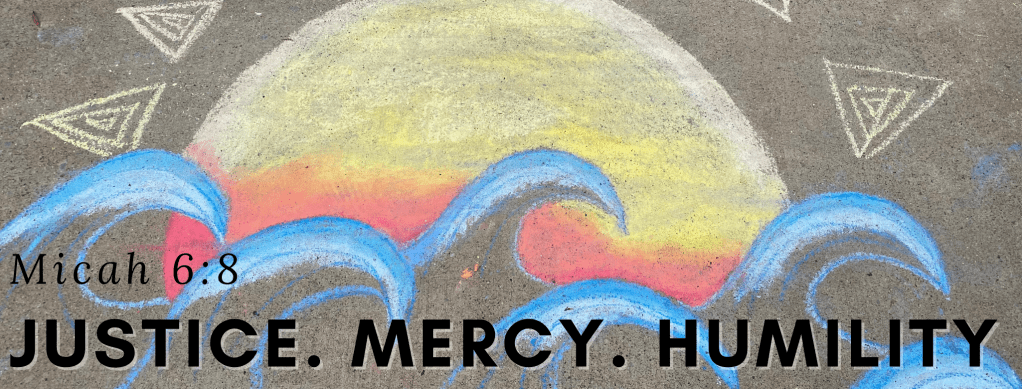
“What does the Lord require?”

“What does the Lord require?” is a question that Micah addresses in his time, and one we are asking today. For the prophet, it was three unique characteristics: God requires justice, mercy, and humility. It seems simple and straight forward, but as I look around our world, I see young people dying because of their skin color. I see mass shootings and wonder how many people have to die before taking a hard look at the culture of violence. I see people looking for freedom and safety for themselves and their families, and they are met with, “Not in my country or not in my back yard.” I see a world looking for a voice—a prophetic voice calling us back into God’s divine image.

For the people in Israel and us, that voice comes from Micah. Micah knew that justice would not come from the state or the power structure, for they get caught up in matters of comfort, prosperity, and security. Justice, as history has shown, arises out of the people themselves, fueled by God’s grace, to envision change, a counter-cultural way of doing things. To do justice is not a romantic ideal nor an abstract concept. Instead, I have found that justice is excruciatingly hard work. For it asks of us as a people to work together, to truthfully critique the present unjust system, and to find new alternatives to change the system.  Justice can disrupt, dismantle, break down, disarm, and transform systems and people when we dare to see what is really happening here and around the world without growing cynical and closed off. We can see all kinds of injustices and tragedies, but seeing it is not enough. For it is in seeing the injustice and being moved to do something about it that we dare to change what is unjust. 

God requires mercy. Jesus embodied this type of mercy as he wept, prayed, broke bread, touched, and healed people. These are real flesh and blood examples of loving-kindness, loving tenderly, loving steadfastly. And, yet, in our society, to love kindness does not come easily. Perhaps that is because loving tenderly involves knowing confidently one is loved and can take the risk to be moved, be vulnerable, and be able to see another person’s suffering as one’s own.

God asks we walk humbly with the Divine. To walk humbly is to neither have your nose up in the air nor your shoulders slouched over your feet. To walk humbly is not to exalt yourself, not to worry or be bothered by other people’s opinions of you. To walk humbly is not to be above someone or below someone, but rather with someone. It is not thinking you can do it all on your own, carrying the burdens upon your limited human shoulders. It does not forget you are human. It is not living without grace. It is not playing God. Walking humbly with God is about paying attention, paying attention to who we are and what is around us, listening to the cries and the stories of other human beings, and our own stories, waiting on God. We must know our story before we can be there for another. We must love ourselves before we can love another.

“What does the Holy One require of us? To make justice happen; to love passionately as the Holy loves; and to be the Divine image in the world!” (Micah 6:8, Rev. Dr. Lisa Davison translation)

Called

Have you ever felt out of sorts? Have you ever felt restless, like you just can’t get comfortable? Have you ever felt disoriented or lost? Maybe you’ve felt this way when changing schools, moving to a new home, or starting a new job.


I’ve come to learn that the times I feel most uneasy are the times when I’m expecting to be on the verge of a major transition or shift in my life. I get an itch for something exciting, I get a craving for something new. If I give myself enough time for reflection, I realize that I’m not allowing myself to be satisfied with what’s in front of me. I want to be called into a new season of life, or to a new place, or to be with new people. This usually comes when I’m a little too focused on what I do instead of who I am.


“Your ‘calling’ is not your dream job. It’s not your soul mate. It’s not your family. Those are goals and obligations. Your calling doesn’t wait for you on a distant horizon, nor does it tap impatiently on the door of your heart. That’s passion and excitement. Your calling isn’t the siren song of a foreign land. That’s wanderlust. Your calling isn’t where you live, or what you do, or even who you love. Your calling is your innate character combined with the experiences and education that brought you to this point, right now, today. Your calling isn’t a thing that’s waiting to be discovered. It’s who you are in relation to where you live and what you do and how you serve the people around you. So you don’t have to wonder anymore; YOU ARE CALLED. You’ve always been called. Every single day when you manage to get out of bed and show up for the life you’re living, you’re answering God’s call.” –Jamie Wright


You, and I, are called to build the kin-dom, restore hope, and live joyfully. This is no easy task, but with the help of God, all things are possible. So, let’s get to work, claiming our gifts, using our gifts, changing the world.

Sinner / Saint

Several years ago, while walking around the French Quarter, I came across a bar entitled Sinner and Saint. A perfect name for a bar. A perfect name for a church. Often in our world, we live by this binary, in and out or up and down dichotomy. You are either this or that, and couldn’t possibly be both. Often this limited view of the world, or those living in it, keeps us from embracing the beautiful tapestry of God’s diverse creation. It divides us into tribal groups, which can make us feel accepted, wanted, and loved, and, at the same time, elusive to the other who does not fit into our tribe or group. You are either a saint or a sinner, right?

If we are honest with ourselves, we are both. Peter is the perfect biblical example. Take for example Matthew 16. In verse 18, Jesus claims that Peter will be the rock on which he will build his Church. Peter will serve as the foundation, the model for what would become. High praise and honor, which would lead us to see only protentional and possibility for this disciple. Yet, just five verses later, Jesus turns to Peter and says, “Get behind me, Satan! You are a stumbling block to me; you do not have in mind the concerns of God, but merely human concerns.” Such extremes found in one person. Such extremes found within us all.

There is an old Cherokee story of a grandfather teaching his grandson about life. “A fight is going on inside me,” he said to the boy. “It is a terrible fight and it is between two wolves. One is evil – he is anger, envy, sorrow, regret, greed, arrogance, self-pity, guilt, resentment, inferiority, lies, false pride, superiority, and ego.” He continued, “The other is good – he is joy, peace, love, hope, serenity, humility, kindness, benevolence, empathy, generosity, truth, compassion, and faith. The same fight is going on inside you – and inside every other person, too.” The grandson thought about it for a minute and then asked his grandfather, “Which wolf will win?” The grandfather simply replied, “The one you feed.”

As we acknowledge the two wolves wrestling inside us, may we strive to lean toward joy, peace, love, hope, serenity, humility, kindness, benevolence, empathy, generosity, truth, compassion, and faith. May we claim and feed the wolf that is good.  Desmond Tutu once said, “We are made for goodness. We are made for love. We are made for friendliness. We are made for togetherness. We are made for all of the beautiful things that you and I know. We are made to tell the world that there are no outsiders. All are welcome: black, white, red, yellow, rich, poor, educated, not educated, male, female, gay, straight, all, all, all. We all belong to this family, this human family, God’s family.”

Feed the Good. Be the Good.

Unplugging

Hand holding the plug, blackboard

We all need to be loved and to feel needed, but social media has given us a false sense of community. It has damaged our self-worth, and although we are more connected than ever, we are left many times feeling very alone. It’s not reality because it does not give full breadth and depth, only surface and projections.

Two years ago, my family went to Disney. It was a wonderful trip. We spent seven days eating with Mickey, riding with Donald, and took a picture with every prince and princess we could find. Throughout the week, I posted tons of pictures, all of our family smiling and enjoying the week. From a social media perspective, you would have thought my daughter was an angel and that every hour of every day was the best! But that would have been untrue. She was 6. She had meltdowns and temper tantrums, but those pictures never made it to Instagram or Facebook. People don’t often post the ugly or the darkness that comes with life. They post joyfully happy pictures, and when we scroll through our feeds, we often feel that our life should be that way too, even when we know it’s not. We question ourselves, and we wonder why our life can’t be like theirs, but the truth is their life isn’t like that either. It’s a false narrative, and it sets up unrealistic expectations that no person or family can achieve. It’s a photoshop of reality.

Social media, which our phones allow us to constantly connect to, have created a false self-image of our world and ourselves. When put down our phones, when we unplug from social media, we stop seeing ourselves as the world sees us, and begin to see the way God created us to be. Unique, special, different, a little weird, and beautiful. We find our real identity, that person God created us to be. We remember who we are and Whose we are.

Putting down the phone helps us find wholeness, order, renewed spirit, empowered emotions, healthy bodies, renewed mind, authentic relationships, and nurtured sense of ourselves that Sabbath-keeping creates. This practice of unplugging does not remove us from the world, rather it gives us permission to rest from the world, so that we can plug into ourselves and God.  Jesus knew that better than anyone. Time and time again, he would find time to pray, to rest in his ministry. It’s why he calls us this day to find rest in him.

Be Still

Being still is an issue most of us struggle with. Even in this time of COVID, where daily patterns have shifted, many have found new and creative ways to fill our days with stuff to do. For years, when we engaged in conversation, we would often ask, “How are you doing?” The response was often, “I’m fine! School or work is fine, parents are fine, sports are fine”…you get the gist. But according to a sermon preached by Rev. Danny Gulden last year, a shift has occurred from being fine as our normal response to “I’m busy. I am crazy busy.” Busy has become our new standard answer to the question, “How are you doing?”

In our fast-paced society, we receive plenty of signals to keep ourselves crazy busy. We drive fast cars, we eat fast food, we feel compelled to get on the fast track, to take the hardest classes, and to not only succeed, but stand ahead of the pack. When you add in our digital connections competing for our attention and our time, we have little room for self-reflection and growth.

Edward Hollowell is quoted as saying “Without intending for it to happen or knowing how it got started, many people now find they live in a rush they didn’t want and didn’t create or at the very least, didn’t mean to create.” Somehow, the pace of our lives, and the ceaseless activity around us, has left us empty and exhausted.

Many years ago, a poet, a person of wisdom, wrote the prescription for what ails us today. “Be Still. Be Still and Know that I am God.” This prophet of old is reminding us to slow down, to embrace that “Breathe” ding your iWatch gives you, at the most inopportune time of the day. We are being called to live into our own pace in life and not conform to the societal pressures that more or faster is better. Jesus never talked about crossing items off to-do lists. Life is not a competition for us to conquer or win. It’s to be lived and enjoyed. As Eyen Gardner said, “Being still does not mean don’t move. It means move in peace.” May you find peace this day, as you live into the pace God has set for you.

Perfect Harmony

Business on top, party on the bottom is the best way I can describe my outfit these days. Ever since the pandemic, I have had most of my meetings online. Given this limited view, I have found my dress typically consists of a dress shirt, paired with gym shorts. It’s an odd look for sure, but it’s comfortable. What has been your style during these past few months?

When I think of biblical clothing, I don’t envision long robes and Birkenstocks, but Colossians 3:12-14, where Paul says, “As God’s chosen ones, holy and beloved, clothe yourselves with compassion, kindness, humility, meekness, and patience.  Bear with one another and, if anyone has a complaint against another, forgive each other; just as the Lord has forgiven you, so you also must forgive.  Above all, clothe yourselves with love, which binds everything together in perfect harmony.”

In our imperfect world, these clothing items are often hard to wear. At times they seem out of style as the world pushes us to focus only on our own wants and desires. Pronouns like “we” and “us” give way to “”me” and “mine” as we move toward individualism, leaving the collective behind. And at what cost?….Perfect harmony.

So how do we get our sense of fashion back? Embracing compassion, kindness, meekness, patience, and humility. Frederick Buechner says this about humility: “True humility doesn’t consist of thinking ill of yourself but of not thinking of yourself much differently from the way you’d be apt to think of anybody else.” In other words, a humble lifestyle, a lifestyle in perfect harmony with the world and with God is living the Greatest Commandment, which calls us “to love God and to love your neighbor as you love yourself.”

So, let’s get dressed up as we seek to understand someone else’s life. Let’s boldly walk the runway of life as we move beyond hoping the best for someone, but actively seeking love and justice for other people. Let’s clothe ourselves with love, as “me” gives way to “we.”

‘Tis the Season

In and out. Up and down. Life is a journey filled with successes and failures, wins and losses.  A pastor once said, “In weather, there are four seasons. But in your life, there are dozens of different seasons. And every season of life includes both good and bad times.”

Like many of you, I am ready for this season to be over. I am ready to return to a time when I was mask free, could travel unrestricted, and where friends abound.  I’m ready for my old rhythm of life to return, one that gave me comfort and security.  I’m ready to step beyond the upside down, and find a world unconsumed by the Mind Flayer,  the Shadow Monster, or as we know it Covid-19.

The passage I wanted to share today is Ecclesiastes 3 with its poetic litany of the ups and downs of life. Words written more than two thousand years ago, yet they encompass the full range of contemporary human emotion and experience, that we will experience in our life, some in the past few months.

Here now these words.

There’s a season for everything

    and a time for every matter under the heavens:

     a time for giving birth and a time for dying,

    a time for planting and a time for uprooting what was planted,

     a time for killing and a time for healing,

    a time for tearing down and a time for building up,

     a time for crying and a time for laughing,

    a time for mourning and a time for dancing,

     a time for throwing stones and a time for gathering stones,

    a time for embracing and a time for avoiding embraces,

     a time for searching and a time for losing,

    a time for keeping and a time for throwing away,

     a time for tearing and a time for repairing,

    a time for keeping silent and a time for speaking,

     a time for loving and a time for hating,

    a time for war and a time for peace.

Seasons, Change, and Purpose. Life is full of seasons, and they change from one to another each with their own purpose and importance.  Anthony Bourdain has this fantastic quote, “Travel isn’t always pretty. It isn’t always comfortable. Sometimes it hurts, it even breaks your heart. But that’s okay. The journey changes you; it should change you. It leaves marks on your memory, on your consciousness, on your heart, and on your body. You take something with you. Hopefully, you leave something good behind.

Although we may not be traveling much these days, the life we live is in a sense a journey, the ultimate travel experience as we traverse its mountain top highs, and cavernous valleys below.  With each change, with each season we leave behind some thing, as we move toward something new. It’s not always pretty or comfortable, but through it all, God’s presence is always there.  May we claim that presence, as we travel boldly into this season,  learning more about ourselves and who God is calling us to be in this time and in this place.   

Go Your Own Way

Last week, our daughter Miriam turned 9. Her birthday in the midst of pandemic was like many things we have all experienced over the past months, lackluster and with little fanfare. In all honesty it was a disaster. No party + online schooling + attitude = tears for our daughter and frustrated parents. I wish this terrible, horrible, no good, very bad day was a one-time occurrence. That a wall was hit or the last straw broken. I wish I could say these outbursts only happen every once in awhile. I wish that was true, but it’s not. Lately, being a parent has been difficult. We have struggled with push back and a lack of desire to do what is right or has been asked.

I’m sure we are not alone. I am sure our daughter, if she knew the song, would quote Will Smith by saying, “Parents just don’t understand.” And yet, I still wish she would listen as we try to guide, love, and help her during these very difficult times.

I wonder if that is how God sees us from time to time. I wonder how often we are the 9-year-old know-it-all who just wants to create TikTok songs, watch Barbie shows on Netflix, and Facetime our friends. Sure we hear the advice, and we know it’s the right thing to do, but we just don’t want to. We, instead, choose to do our own thing, and our shortsightedness overshadows the larger arc of life.

Throughout the biblical text, we are reminded of those who failed to see the bigger picture. Instead of listening to God or their parents, they chose to blaze their own path at the expense of themselves and their relationship. Take, for instance, the Prodigal Son, who wants what is his so that he can live his own life, a life far away from parents and family to help guide and love him. The consequence of such actions did not end well for him. Scripture says, “Finding himself destitute and in the midst of a severe famine in the land, he hires himself out to a pig farmer. Seeing firsthand that the pigs were eating better than him, he decides to return to his father and beg to be allowed to serve as a hired servant on the estate.”

When the son returns, we experience a truth. It is the same truth I tell my daughter before she goes to bed. I love you! Sure, last Monday was a terrible, horrible, no good, very bad day. We have raised our voices, and we have frustrated each other to the point of exhaustion. So many things could have gone better, and, yet, the truth remains. I love you.

On this day, may we be reminded of God’s love even when we fall short of the big picture. God is always there to welcome us home, and to remind us that even on the worst days, we are still loved.